

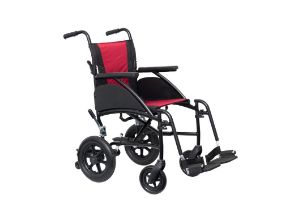
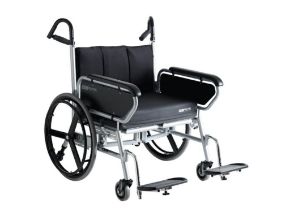
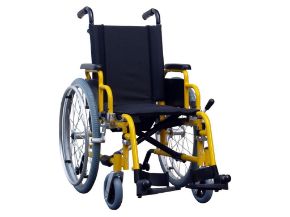
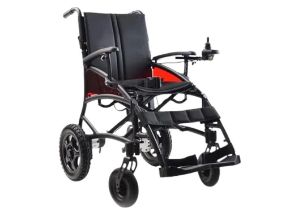










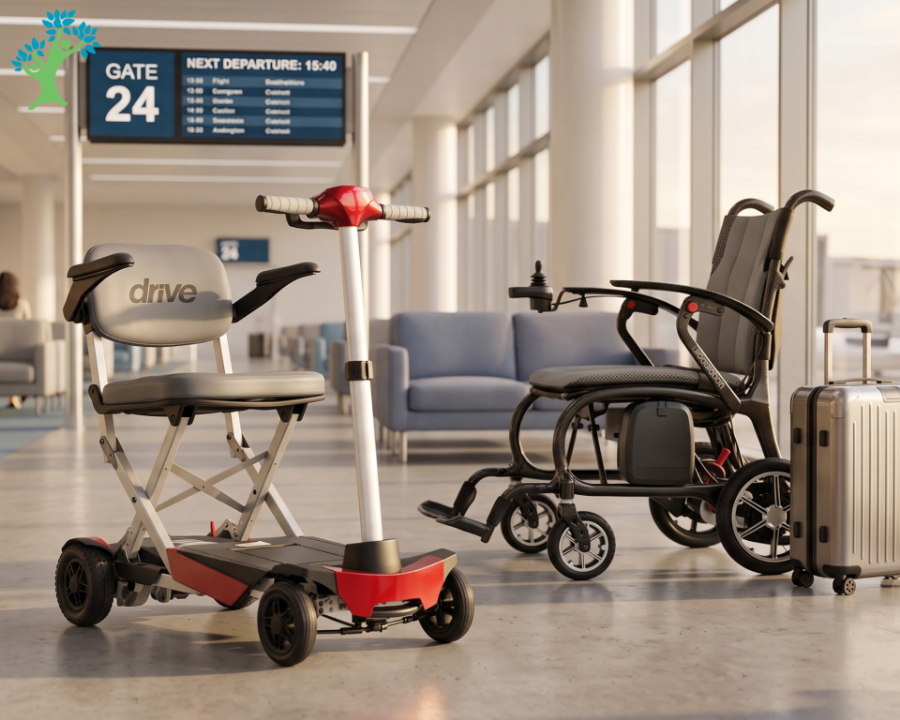
If you've searched "airline-approved mobility scooter" or "can I take my powerchair on a plane," you've probably found no shortage of advice. UK retailers, insurers and US mobility companies have all written extensively on the subject. Our own general guide to air travel with mobility scooters and powerchairs covers the essential first steps for anyone flying with their equipment.
But we went looking for how well that advice actually serves someone shopping for a scooter or powerchair in Ireland, someone who wants to buy the right device the first time, knowing it'll fly with Aer Lingus or Ryanair without drama. And we found some real gaps. Most of what ranks well is written for a UK audience (CAA, FCA-regulated insurers) or a US one (TSA, FAA, watt-hour rules pitched at domestic carriers). Very little of it mentions the regulator that actually governs your rights at Dublin, Cork or Shannon, or gives you real numbers for the two airlines most Irish travellers actually fly.
Here's what we think is missing and what you should actually check before you buy.
Gap 1: "Airline-Approved" Isn't a Real Certification
A lot of scooters are marketed as "airline-approved" or "airline-friendly." It's a useful shorthand, but it can be misleading if you take it too literally: there is no single certifying body that stamps a mobility scooter as officially approved for every airline. What the term really means is that a scooter's battery, weight and folded dimensions sit comfortably within the limits that most airlines apply. This is typically a lithium-ion battery under 300Wh, and a folded size and weight that fit into a standard cargo hold.
That's a helpful starting point, but it's not a guarantee. Every airline, and in some cases every aircraft type on a given route, can apply its own final say. A scooter that's "airline-approved" in principle can still be refused if you haven't notified the airline in time, or if the battery documentation isn't to hand at check-in. Buy for compliance, but plan for notification too.
Gap 2: The Regulator You Should Actually Know Is the IAA, Not the CAA or the TSA
Almost every UK guide we reviewed references the Civil Aviation Authority (CAA). Almost every US guide references the TSA or FAA. Both are useful for general context on lithium battery safety, but neither is the body that governs your rights as a passenger with reduced mobility flying from an Irish airport.
That's the Irish Aviation Authority (IAA). Under EU Regulation 1107/2006, which applies across the EU including Ireland, passengers with reduced mobility are entitled to free assistance at Irish airports - from check-in through to boarding and baggage reclaim. The IAA is the National Enforcement Body responsible for monitoring this and for investigating complaints if that assistance isn't provided, or if your equipment is lost or damaged during handling.
Two things worth knowing:
- If you request assistance more than 48 hours before departure, the airport authority is obliged to provide it.
- If you give less than 48 hours' notice, they're required to make every reasonable effort, but assistance can't be guaranteed.
If something goes wrong, a wheelchair damaged in the hold, or assistance not showing up, your first port of call for a formal complaint about an Irish airport or a flight arriving into one is the IAA, not the airline's own customer service department.
A note on airports beyond the big three: Ireland West Airport (Knock), Kerry Airport (Farranfore), and Donegal Airport all operate scheduled international flights, Knock and Kerry to the UK and Europe, Donegal with a regular Glasgow service, and the same IAA rules and EU Regulation 1107/2006 rights apply there too.
Gap 3: Real Numbers for Aer Lingus and Ryanair (Not Just "Check the Airline's Website")
Most of the guides we looked at stop at "contact your airline for their specific limits." Fair enough, policies change, and we'd rather send you to the source than publish numbers that go stale. But it's worth knowing roughly what you're working with before you start that conversation, and before you buy.
Ryanair, based on their current Help Centre guidance:
- Folded/collapsed dimensions must not exceed roughly 81 cm (height) x 119 cm (width) x 119 cm (depth) to fit through the cargo hold door.
- Devices over 150 kg require pre-authorisation and won't be accepted without it.
- Lithium-ion batteries are capped at 300Wh for a single battery, or 160Wh each where two batteries are used.
- Ryanair will only carry two electric wheelchairs or mobility scooters per flight, so book your equipment onto the flight as early as possible, ideally at the time of booking.
- The battery must be isolated (key removed, joystick deactivated, or via an isolation switch) so it can't be accidentally activated in the hold.
Aer Lingus, based on their current Special Assistance guidance:
- Passengers with a disability or reduced mobility can travel with up to two pieces of mobility equipment free of charge.
- Assistance is arranged through their Special Assistance channel rather than standard booking, and both your departure and arrival airports are notified in advance.
- In exceptional circumstances requiring an alternative seating arrangement, special IAA authorisation may be needed — another reason the IAA, not just the airline, matters here.
None of the UK or US guides we reviewed mention these specifics, because they're simply not written with Aer Lingus or Ryanair passengers in mind. If you're buying with air travel in mind, use these figures as your working budget, then confirm directly with the airline's special assistance team before you book.
Gap 4: The Watt-Hour Calculation Most Guides Mention but Don't Actually Show You
Nearly every source touches on the 300Wh lithium battery limit (and the 160Wh-per-battery rule for scooters with two batteries), but few walk through how to work it out if the battery itself doesn't quote a Wh figure. It's simple maths:
Watt-hours (Wh) = Voltage (V) x Amp-hours (Ah)
- A 25.2V battery rated at 10Ah = 252Wh - under the 300Wh limit, and fine to fly with. Example is the Manual fold Plus Scooter.
- A 25.2V battery rated at 15Ah = 382.5Wh - over the limit, and likely to be refused.
- A scooter with two 24V, 6Ah batteries = 144Wh each - under the 160Wh-per-battery limit for twin-battery setups.
This is a calculation worth doing before you buy, not just before you fly. If you're choosing between two similar scooters and one has a slightly larger battery for extra range, that extra capacity could be the difference between a device that flies without issue and one that needs a battery swap before every trip.
Gap 5: Non-Spillable Lead-Acid Batteries Get Skipped Almost Entirely
Every guide we reviewed focuses heavily on lithium-ion batteries, which makes sense, most new travel scooters use them. But a fair number of scooters and powerchairs, especially older or heavier-duty models, still run on sealed, non-spillable lead-acid (SLA) or gel batteries, and almost nobody explains how the rules differ.
Non-spillable lead-acid batteries aren't subject to the same 300Wh (or 160Wh-per-battery) watt-hour limits that apply to lithium-ion. Instead, the key requirement is that the battery is genuinely non-spillable, meaning it's sealed so it can't leak electrolyte regardless of orientation, and this needs to be verifiable, usually via a manufacturer's label or spec sheet confirming "non-spillable" or "valve-regulated lead-acid (VRLA)" construction.
A few things worth knowing if your scooter or powerchair runs on lead-acid rather than lithium:
- You don't need to do a watt-hour calculation. The Wh limit is a lithium-ion rule; it doesn't apply to non-spillable lead-acid batteries.
- Both Ryanair and Aer Lingus accept non-spillable lead-acid batteries as part of their standard mobility equipment policies, though you should still notify them in advance and confirm current requirements.
- The terminals still need to be protected against short-circuit for transport, the same as with lithium batteries, even though the watt-hour rule doesn't apply.
- Ask the manufacturer or retailer directly whether the battery is non-spillable if it isn't clearly labelled, this is the one document you genuinely need before you fly, and it's worth confirming before you buy too, particularly with older or second-hand equipment.
If you're comparing a lithium-ion model against a lead-acid one purely on flight-friendliness, lead-acid isn't automatically the harder option, it just needs a different piece of documentation, not a maths problem.
Gap 6: What "Buying for Portability" Actually Means
Most retailer guides list "lightweight and foldable" as a feature without explaining what that means for someone who plans to fly. A few practical things to check at the point of purchase, not after:
- The weight of the heaviest single component, not just the total weight of the scooter. If it splits into pieces for the hold, you (or whoever's helping you) need to be able to lift the heaviest piece, many travel scooters aim for a heaviest component under 15–16 kg.
- Whether the battery is designed to be removed easily. Airlines increasingly expect lithium batteries to travel in the cabin, separate from the scooter body, protected against short-circuit. A battery that's awkward to remove is a genuine inconvenience at every airport, every trip.
- Whether the battery and its documentation are clearly labelled with voltage, amp-hours or Wh rating, and chemistry type. A missing or worn label has caused real, documented cases of passengers being refused boarding, not because their equipment wasn't compliant, but because staff couldn't verify it on the day.
- Folded dimensions against the aircraft types you're likely to fly. A scooter that folds small enough for a Ryanair 737 hold door should comfortably suit most short-haul European flying from Ireland.
Gap 7: Your Rights (and Recourse) Under EU and International Law
Several UK sources mention the Montreal Convention 1999 in relation to airline liability for damaged mobility equipment, which is useful but they typically frame it around UK domestic complaint routes. For Irish travellers, it's worth knowing:
- Under the Montreal Convention, airlines have limited liability for damage to checked mobility equipment (a fixed amount in Special Drawing Rights, roughly a few thousand euro), unless you've made a special declaration of value in advance and paid any applicable fee.
- Under EU Regulation 1107/2006, separate from Montreal Convention liability, you have a right to assistance and to have damaged or lost mobility equipment addressed by the airport or airline.
- If your equipment is damaged, report it immediately at the airport before you leave, a Property Irregularity Report, or its equivalent, is far harder to pursue after the fact.
- Complaints about assistance (rather than damage) at an Irish airport, or on a flight arriving into one, go to the IAA.
Given the value of most mobility scooters and powerchairs, it's worth asking your airline about declaring a higher value, and considering equipment insurance separately which brings us to the next gap.
Gap 8: Insurance Guides Are Almost All UK-Regulated
Several of the sources we reviewed recommend mobility scooter insurance for holiday travel, which is sound advice, battery failures, theft and damage abroad do happen. But the insurers referenced are typically FCA-regulated UK companies, and their travel cover explicitly separates UK/GB cover from wider international policies. Before assuming a UK-based mobility insurance policy will cover you as an Irish resident flying from Dublin, Cork or Shannon, check:
- Whether the policy is available to Irish residents at all, and under what regulatory framework it operates here.
- Territorial limits, many "worldwide" policies exclude North America and Canada, and some UK-domiciled policies may have Ireland-specific exclusions or require a UK address.
- Whether your policy covers the scooter in the cargo hold specifically, not just while in use.
If in doubt, ask an Irish-based broker or your existing home/travel insurer whether mobility equipment can be added as a named item, rather than assuming a UK guide's recommended provider applies to you.
Gap 9: Local Support That UK and US Guides Simply Can't Offer
This is the biggest structural gap. None of the international sources can tell you about supports that only exist in Ireland:
- Zero-rated VAT on mobility scooters and powerchairs. These are VAT-free at point of sale in Ireland, not a relief or refund you need to claim back, worth knowing so you're not caught out by a retailer quoting a VAT-inclusive price.
- HSE and local authority grants that may apply to certain mobility equipment purchases.
- In-person demonstrations and fitting advice from Irish showrooms, where you can physically test how a scooter folds, how heavy the components feel to lift, and whether the battery is easy to remove, all the things a spec sheet can't fully convey.
If you're weighing up a travel scooter purchase, it's worth having this conversation with an Irish retailer directly, rather than relying solely on a UK product page.
The Keyword and Topic Gaps, at a Glance
For anyone else researching this space, here's a shortlist of the questions Irish searchers are asking that the current crop of guides, including some of our competitors, don't answer well:
- Ryanair mobility scooter weight and dimension limits
- Aer Lingus lithium battery watt-hour rules
- Irish Aviation Authority special assistance complaint
- Dublin Airport / Cork Airport wheelchair assistance booking
- Zero VAT mobility scooter Ireland
- HSE mobility scooter grant
- EU Regulation 1107/2006 mobility equipment rights
- Is my mobility scooter insured in Ireland for flying
- Montreal Convention mobility scooter compensation Ireland
- Non-spillable lead-acid battery mobility scooter flight
A Quick Pre-Purchase Checklist
Before you buy a scooter or powerchair with air travel in mind:
- Check the battery chemistry first: for lithium-ion, note the voltage and amp-hour rating and calculate the Wh figure yourself; for non-spillable lead-acid, confirm it's labelled as such rather than calculating Wh.
- Confirm the folded dimensions and the weight of the heaviest single component.
- Check whether the battery is designed to be removed easily and is clearly labelled.
- Decide which airline(s) you're likely to fly with most often, and check their current mobility equipment policy directly. This is really important if you plan to transfer for onward travel after a short flight to a major international hub.
- Confirm the price you're quoted is VAT-free, as it should be, and ask about grant eligibility before you pay.
- Consider insurance cover that's actually valid for an Irish resident travelling internationally.
Frequently Asked Questions
Is there an official "airline-approved" certification for mobility scooters?
No single certifying body issues this label. It's an industry shorthand meaning the battery, weight and folded dimensions typically meet common airline limits, most often a lithium battery under 300Wh and a size that fits a standard cargo hold. Final acceptance is always at the airline's discretion.
Who regulates passenger assistance rights at Irish airports?
The Irish Aviation Authority (IAA), under EU Regulation 1107/2006. They're also the body to complain to if assistance isn't provided or your equipment is damaged at an Irish airport, or on a flight arriving into one.
How much notice do I need to give an airline before flying with a mobility scooter?
Most airlines, including Aer Lingus and Ryanair, ask for at least 48 hours' notice, and recommend notifying them at the time of booking. Giving less than 48 hours' notice means assistance is not guaranteed, only "reasonable efforts."
How do I work out my battery's watt-hour rating?
Multiply the voltage (V) by the amp-hour rating (Ah). For example, a 24V, 12Ah battery is 288Wh. Most airlines cap a single lithium battery at 300Wh, or 160Wh each if your scooter uses two batteries.
Do the watt-hour battery rules apply if my scooter uses a lead-acid battery, not lithium?
No. The 300Wh (or 160Wh-per-battery) limit is a lithium-ion rule. Non-spillable lead-acid or gel batteries aren't subject to it, but you'll usually need to confirm in writing, or via the manufacturer's label, that the battery is genuinely non-spillable.
How many mobility scooters can I bring on a Ryanair flight?
Ryanair currently accepts a maximum of two electric wheelchairs or mobility scooters per flight, due to hold space, so book yours in as early as possible.
Does Aer Lingus charge extra for mobility equipment?
No. Passengers with a disability or reduced mobility can travel with up to two pieces of mobility equipment free of charge.
What happens if my scooter is damaged during a flight?
Report it immediately at the airport before leaving, and request a written report. Airline liability for checked mobility equipment is limited under the Montreal Convention unless you've declared a higher value in advance, so consider separate insurance for your equipment's full value.
Is UK mobility scooter insurance valid for Irish residents?
Not always. Many UK-based policies are aimed at UK residents and regulated accordingly. Check territorial cover and eligibility with the insurer, or speak to an Irish broker, before assuming your cover applies.
Can I get financial help buying a travel-ready mobility scooter in Ireland?
Mobility scooters and powerchairs are zero-rated for VAT in Ireland, so you shouldn't be charged VAT on the purchase at all. Certain HSE or local authority grants may also apply depending on individual circumstances, it's worth asking an Irish retailer directly what you may be eligible for.
Where can I see airline-friendly scooters and powerchairs in person before I buy?
Visiting a showroom lets you check fold time, component weight and battery removal for yourself. You can find our range of mobility scooters and powerchairs online, or visit us in Portlaoise or Dublin to see them for yourself.