









_900.jpeg "Autumn Sun with a Folding Mobility Scooter or Powerchair: Where to Go and How to Make It Easy")
Peak summer is over, and for many of our customers that is precisely the point. Late September and October bring warm-not-hot temperatures, quieter resorts and better prices to the places within a few hours' flight of Ireland, and with the right folding mobility scooter or powerchair, the trip is as simple as any other.
This is a destination-led guide: where the autumn sun still is, how flat and level each place is on the ground, and which of our folding models travel best. For the technical side, battery watt-hour limits, Ryanair and Aer Lingus rules, your rights at Irish airports, our guide to buying an airline-approved mobility scooter or powerchair in Ireland covers it in detail, and our earlier travelling-with-a-mobility-scooter guide covers car boots and insurance. This piece is about the holiday itself.
Why Autumn Suits This Kind of Trip
Retirement and flexible working mean a good share of our customers are free to travel once the school holidays end, and there are real advantages to doing so. Daytime temperatures in the mid-twenties are far kinder for long spells outdoors than the heat of August. Resorts and promenades are quieter, queues are shorter, and flights and hotels are noticeably cheaper. For anyone using a mobility scooter or powerchair, quieter also means easier, there are fewer crowds on the seafront, more space in the café, a calmer airport.
Where the Sun Still Is: A Short Guide
This is a short selection of our recommended destinations rather than an exhaustive list, the places that come up again and again with customers who travel with a scooter or powerchair, and that publish accessibility information you can check for yourself before booking. More than likely, you'll have your favourite desitnation(s), and will know only too well the 'lie of the land'. Typical late-September to October daytime temperatures are given as a guide; check a forecast before you book.
Benidorm, Spain. Around 24–28°C. Widely regarded as one of the most accessible beach destinations in Europe: the Levante and Poniente seafronts are long, completely flat and wide, with smooth ramps leading directly down to the beaches and level access along the whole promenade. A good choice of adapted hotels, and everything a scooter or powerchair user needs within a flat kilometre of the seafront.
Tenerife, Canary Islands. Reliably warm at around 26–28°C, with dependable sunshine well into October. Los Cristianos and Playa de las Américas have invested heavily in smooth, ramped kerbs and accessible coastal boardwalks, and the harbour-front paths are flat and wide. Dedicated accessible holiday complexes, some with pool hoists, make it the most established choice for this kind of trip.
Madeira. Around 23–25°C. Funchal's seafront and the Lido promenade are smooth and level, and the climate is famously gentle. Away from the seafront the island is steep, so plan days around the promenade, the gardens and the cable car rather than the hill streets.
The Algarve (Albufeira or Faro), Portugal. Pleasantly warm at around 23–25°C with plenty of sunshine. Many coastal towns have flat resort centres and boardwalks, and specialist operators offer accessible villas and rentals with roll-in showers. Albufeira's old town has steep lanes and cobbles, but its newer resort areas are level, and the quiet autumn crowds make paths and restaurant terraces far easier to navigate than in peak summer.
Malta. Around 26–28°C in late September, cooler by mid-October. Sliema and St Julian's share a long, flat seafront promenade, and Valletta's main streets are level once you are in, though it is a hilly city overall, and Maltese pavements can be uneven. A good choice for history in warm weather.
Barcelona, Spain. Warm and comfortable at around 22–25°C. A remarkably flat city by the sea, with ultra-wide pavements, smooth modern paving and step-free access across almost the entire metro and bus network. The beachfront boardwalk, the Passeig Marítim, is ideal for a scooter or powerchair, and much of the Gaudí architecture is accessible, a city break rather than a beach break, for anyone who wants sun and culture together.
Gran Canaria (Maspalomas and Playa del Inglés). Around 26–27°C, with reliable sunshine into November. The island's tourist board describes the southern coastal promenade, recently rebuilt from Playa del Inglés through Maspalomas to Meloneras, as complete and easily accessible for wheelchair and mobility scooter users, and the main resorts have hotels with adapted rooms, wheel-in showers and pool hoists. Adapted taxis with lifts cover airport transfers. Commercial centres are ramped, though some older bars and restaurants still are not.
Lanzarote (Puerto del Carmen). Around 26–27°C. Puerto del Carmen's seafront promenade is one of the longest in Europe, flat and smooth for its whole length, and Los Pocillos beach has an amphibious beach wheelchair and an accessible toilet. Several complexes in the resort are built around adapted apartments with pool hoists and hire of mobility aids on site, and the nearby shopping centres have ramps and adapted toilets, a resort designed with this kind of trip in mind.
Which of Our Models Suit the Hold
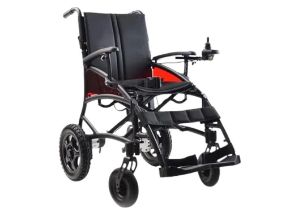
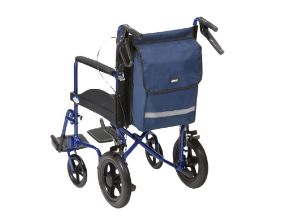
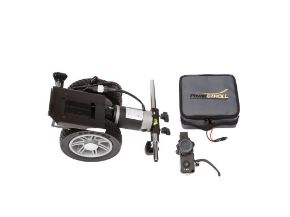
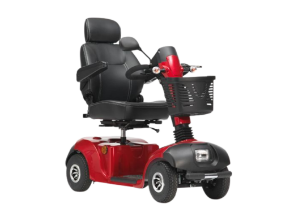
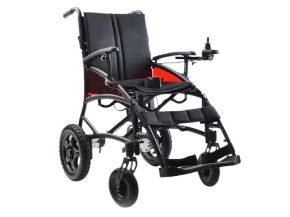
Airlines carry mobility scooters and powerchairs as mobility equipment, usually free of charge and in addition to your baggage allowance. What they need to know in advance is the weight, the folded size and, above all, the battery type. Lithium-ion batteries are capped at 300 watt-hours (Wh) for a single battery, or 160Wh each where two are used. Watt-hours are simply volts multiplied by amp-hours, so a 24V 10Ah battery is 240Wh. The battery is usually removed and carried in the cabin, protected from damage. One practical point worth knowing: Ryanair carries only two electric wheelchairs or mobility scooters per flight, so book early. Our airline-approved guide explains all of this step by step; always confirm the current rules with your own airline when you book.
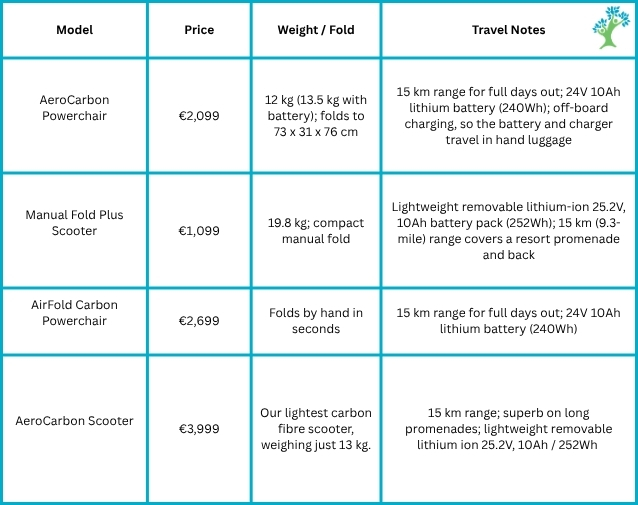
There is no VAT charged on mobility scooters or powerchairs in Ireland, the price you see is the price you pay.
The 48-Hour Rule and the Airport
Tell the airline when you book, or at the very latest 48 hours before you fly; most carriers will not accept a mobility aid at the airport without notice. Have the battery type, watt-hour rating, weight and folded dimensions to hand; we can give you a one-page sheet for your model. Dublin, Cork and Shannon airports all offer assistance from the car park or set-down point to the gate; book it through the airline at the same time. On the day, you can usually drive your scooter or powerchair to the aircraft door, where it is folded and stowed, and it is returned to you at the door on arrival.
On the Ground
- Transfers: a folding scooter or powerchair fits in the luggage bay of a coach or the boot of a taxi; tell the transfer company in advance so they send a suitable vehicle.
- Surfaces: stick to promenades and resort areas, which are built level; old-town cobbles and steep lanes are worth a taxi rather than a battle.
- Charging: the charger works on European sockets with a standard adaptor; charge overnight in your room and start every day full.
- Heat: batteries and motors are happier in the mid-twenties than in August heat; another reason autumn suits this trip.
Make It Familiar Before You Fly
The best time to learn a new scooter or powerchair is not the week before a trip. Choose it now, have it demonstrated in your own home, practise the fold in your own driveway, and it will be second nature by the time you reach the departure gate. Our free in-home demonstration covers the whole Republic of Ireland, Monday to Friday, with no pressure and no obligation. Book online at betterliving.ie or call 0818 989 353, and enjoy the sun that hasn't finished yet.