




Most people picture a powerchair outdoors, on a promenade, in a park, on a day out. In practice, the rooms of your own home are where a powerchair earns its keep, and where the numbers matter most. A chair that is a joy on a wide footpath can be a frustration in a narrow hallway, and the difference usually comes down to three measurements that hardly anyone talks about before they buy.
This guide is about fitting a powerchair to an Irish house: what to measure, what typical homes allow, and what each room asks of the chair. It takes ten minutes and a tape measure, and it will make your shortlist far more useful.
Why the Indoors Should Drive the Decision
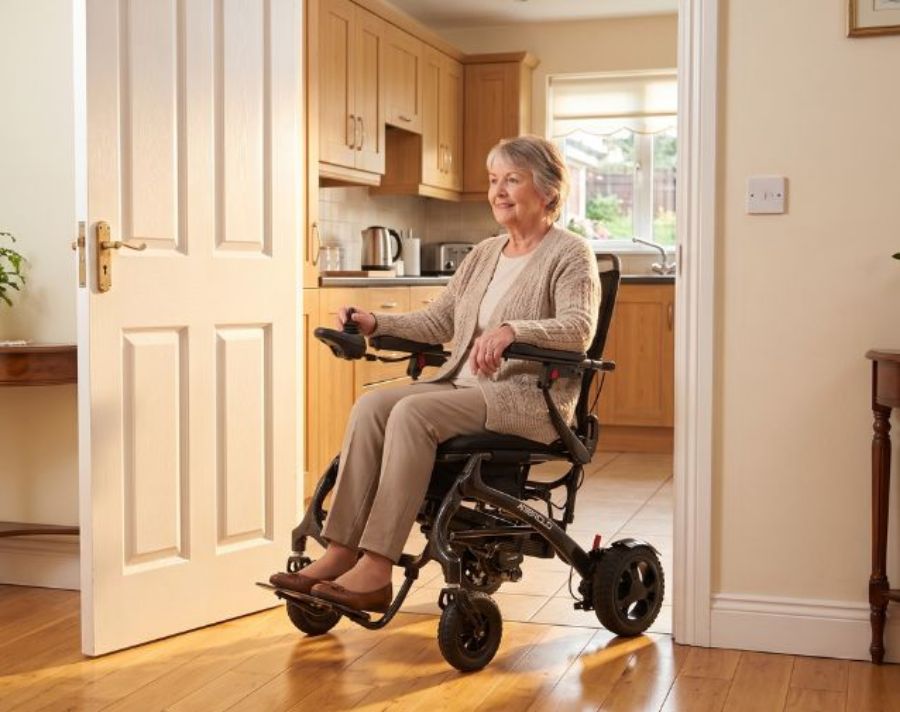
A powerchair is steered from a seated position with a joystick, which gives it a level of low-speed precision that a mobility scooter simply cannot match. That is exactly what indoor life demands: reversing out of a kitchen, turning at the end of a hallway, lining up with a doorway, pulling in under a table. For many of our customers the powerchair is the difference between needing help to move around the house and moving through it comfortably on their own, every day, in every season.
So the first question is not “how far will it go?” but “will it fit, turn and sit well in my home?”. Answer that first, and the outdoor questions tend to look after themselves.
The Three Measurements That Matter
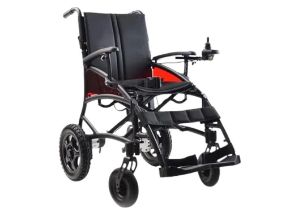
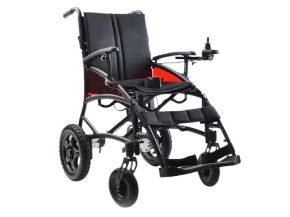
- Chair width. The overall width of the powerchair at its widest point. This is usually the wheels or the armrests. This is the number to hold against every doorway and the narrowest point of every hallway. The AeroCarbon Powerchair, for example, is 61 cm wide.
- Turning circle. The space the chair needs to turn fully around, or to make a right-angle turn from a hallway into a room. Compact indoor powerchairs turn very tightly, but the shape of your hallway, and where the radiator and the hall table sit, decides whether that is enough.
- Seat height. The distance from the floor to the top of the seat cushion, with you on it. It decides whether your knees fit under your kitchen table, whether you can reach the worktop, and how easy it is to transfer to and from your armchair or bed.
Ten-minute tape-measure checklist 1. Measure the clear opening of every internal door you use, the gap between the door stops with the door fully open, not the width of the door itself. 2. Measure the narrowest point of your hallway, including the radiator, the hall table and anything else that sticks out. 3. Measure the space available to turn at the end of the hallway and at the entrance to the kitchen and living room. 4. Measure the height of the underside of your kitchen table and your favourite worktop. 5. Measure the seat height of the armchair and the bed you transfer to most often. 6. Note the height of the step at your front door and any thresholds between rooms. Write the numbers on one sheet and bring it to your in-home demonstration, our specialist will hold each chair against them with you. |
What Typical Irish Doorways Allow
Older Irish homes were often fitted with internal door leaves of around 76 cm / 2ft 6in or 84 cm / 2ft 9in, and once you allow for the frame and the door itself the clear opening is a little narrower again. Newer homes built to the current Building Regulations tend to have wider openings. As a rule of thumb, a powerchair of 61 cm width passes through a standard internal doorway with room to spare on both sides; the chairs that struggle indoors are the wider outdoor models built for endurance rather than agility.
Two things catch people out. The first is the door itself: a door that only opens to ninety degrees because of a radiator behind it takes several centimetres off the usable gap. The second is the approach, a doorway at the end of a narrow hallway needs a chair that can line up straight before it goes through. Both are exactly what an in-home demonstration is for.
Room by Room
Hallway. The hallway is usually the deciding room. Look at the narrowest point, the turn at the end, and the surface. A wooden or tiled floor is ideal; a loose rug is best lifted, because it can bunch under the wheels. Keep the radiator and the hall table in mind when you picture the turn.
Kitchen. Two questions: can you pull in under the table, and can you reach the worktop? A typical kitchen table sits at around 75 cm, so the chair's seat height and armrest height together decide whether your knees fit underneath. Armrests that lift or drop away make a real difference. Reaching the kettle and the sink is about seat height and how close the chair can get to the worktop.
Living room. Carpet matters. A short-pile carpet is no trouble; a deep-pile carpet or a thick rug adds drag and can make tight turns feel heavier. Think about the route from the door to your armchair and whether the coffee table needs to move a few inches.
Bathroom door. Bathroom doors are often the narrowest in the house. Measure the clear opening and, if the chair is not going to go through, plan where it will park while you use a grab rail or a shower seat instead, a good specialist will talk this through rather than gloss over it.
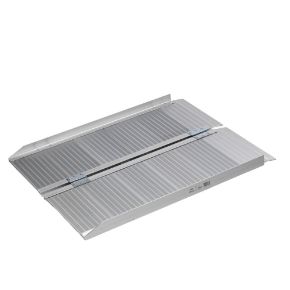
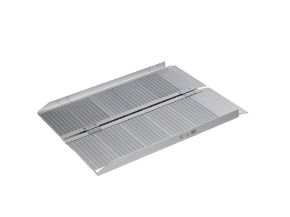
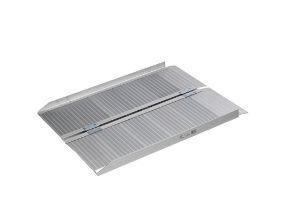
Front step and thresholds. A single low step or a raised threshold is easily managed with a small portable ramp. A higher step at the front door may need a more considered solution, and it is worth raising early.
Joystick Control Indoors
Every powerchair we sell has adjustable speed settings. Indoors, you use the lowest one: the chair moves only as fast as you push the joystick, stops when you let go, and turns on the spot. Most people are comfortable with it within an afternoon. Where a family member will sometimes steer, through a busy doorway, or for someone with limited hand strength, an attendant control at the back of the chair is available on models such as the AeroCarbon.
Folding and Storage in a Home with Limited Space
If the chair has to live in a hallway or a small porch, its folded size matters as much as its driving width. The InstaFold Powerchair (€999) folds flat in a single action and is the most compact and most accessible chair in our range. It is a natural first powerchair for anyone whose priority is getting around the house. The AeroCarbon Powerchair (€2,099) folds to 73 cm x 31 cm x 76 cm, weighs 12 kg to lift, and adds the precision and lightness of an aerospace-grade carbon fibre frame; it is the chair for someone who wants one powerchair for the hallway and the car boot alike. The AirFold Carbon (€2,699) folds by hand in seconds and gives a longer 15 km range for anyone who also plans full days out.
Powerchair | Price | Folded / weight | Best for indoors |
€999 | Folds flat, one action | First powerchair; hallway and kitchen; tight storage | |
€2,099 | 73 x 31 x 76cm; 12kg | Doorway precision plus easy lifting into the car | |
€2,699 | Hand-fold in seconds | Indoors plus longer days out on one charge |
There is no VAT charged on powerchairs in Ireland, not a relief scheme, not something to claim back later. The price you see is the price you pay.
Charging at Home
Plan where the charger will live before the chair arrives. Off-board charging, where the battery lifts out and charges on a shelf or worktop, as on the AeroCarbon, means the chair itself does not need to sit beside a socket. A permanent charging spot near a socket, out of the hallway, is one of those small arrangements that makes daily life simpler; an overnight charge is the usual routine.
What an In-Home Demonstration Checks That a Showroom Cannot
A showroom lets you compare chairs side by side. It cannot tell you whether a powerchair turns at the end of your hallway, pulls in under your table, or clears the rug in your living room. A free in-home demonstration can, because it happens exactly where the chair will be used. One of our specialists brings a small, relevant selection based on what you have told us, and the measurements from your checklist, and lets you try each one in your own space, at your own pace, with no pressure and no obligation. We cover the whole of Ireland, Monday to Friday, at a time that suits you.
Book a Free In-Home Demonstration
If a powerchair is on your mind mainly because of life at home, measure first, shortlist second, and then let us bring the shortlist to your door. Book online at betterliving.ie or call us on 0818 989 353. Our Dublin and Portlaoise showrooms are also open, no appointment needed.