


_900.jpeg "How Heavy Is Too Heavy? The Irish Guide to Mobility Scooter and Powerchair Weight (2026)")
Most people choosing a mobility scooter or powerchair start with the same three questions: what does it cost, how far will it go, and how fast is it? Weight rarely makes the list. Then delivery day comes, the car boot opens on the driveway, and suddenly it's the only number anyone is talking about.
One of the questions we hear most often on home demonstrations isn't about range or speed at all. It's “who is going to lift this?” This guide is about answering that before you buy, with the real weights of every folding mobility scooter and powerchair we sell, in terms that make sense at an Irish car boot, an Irish front door and an Irish airport. This 'Irish' distinction is important as there is any amount of online advice but it is not relevant or useful to an Irish audience.
Four Weights Hiding in Every Spec Sheet
“Weight” on a product page can mean four quite different things, and mixing them up is one of the most common reasons people end up with the wrong model.
- Total weight. The whole machine and battery. It's the figure that matters if the scooter or chair is moved as one piece, but for anything that comes apart, it can be misleading.
- Heaviest single lift. The heaviest piece you will physically pick up. For a scooter that dismantles, or a chair with a removable battery, this is the number your back actually cares about. The AstroLite weighs 27.5 kg in total, yet no single piece is over 10 kg. The Jaunt weighs 48 kg complete and its two sealed lead-acid batteries account for 9kg of that, but its heaviest section is 15.9 kg.
- Battery weight and watt-hours. Lithium batteries are light (the AeroCarbon Scooter's weighs 1.7 kg), and lifting the battery out first takes weight off every lift. If you fly, the battery's watt-hours (Wh) matter far more than its kilos. More on that below.
- Maximum user weight. How much the scooter or chair is built to carry. This is the one number that is never negotiable. Most of us in Ireland still think about body weight in stone, so we've given both throughout.
What 12 kg Actually Feels Like
Twelve kilos means very little on a spec sheet. A 10 kg bag of potatoes means a lot more. So does the 20 kg checked suitcase you've wrestled onto the scales at Dublin Airport. Here is our folding range grouped by the heaviest single lift, in everyday terms:
Lighter than a bag of potatoes (under 10 kg per piece). The AstroLite, which dismantles so that nothing you lift weighs more than 10 kg.
A bag of potaotes and a bit (12–16 kg). The AeroCarbon Powerchair (12 kg), the AeroCarbon Scooter (13 kg with the battery out), the Air Active (15 kg heaviest piece), the AirFold Carbon Powerchair (15.85 kg without its battery) and the Jaunt (15.9 kg heaviest piece). This is the range many people find they can lift into a boot on their own, provided heavy lifting isn't something they've been advised to avoid.
A full checked suitcase (around 20 kg). The Manual Fold Plus, which folds as one 20 kg unit. There's nothing to take apart, but it's the full weight every time.
More than a checked bag (23 kg and up). The InstaFold Powerchair, the InstaFold Scooter and the AutoFold Elite are each over 23 kg even with the battery out. For most households that's a two-person lift, or a model that mostly stays at home which, as we'll see, can be exactly the right choice.
The Heaviest Lift, Model by Model
Model | Type | Heaviest single lift | Total weight | Max user weight | Price |
Scooter · dismantles | Under 10 kg | 27.5 kg | 120 kg / 19 st | €1,999 | |
Powerchair · folds by hand | 12 kg (battery out) | 13.5 kg | 136 kg / 21.4 st | €2,099 | |
Scooter · single-action fold | 13 kg (battery out) | 15.44 kg | 125 kg / 19 st | €3,999 | |
Scooter · splits apart | 15 kg | 26 kg | 120 kg / 18.9 st | €1,099 | |
Powerchair · folds by hand | 15.85 kg (battery out) | 18.5 kg (with battery & accessories) | 115 kg / 18 st | €2,699 | |
Scooter · 5 parts | 15.9 kg | 48 kg | 136 kg / 21 st | €799 | |
Scooter · folds as one unit | 20 kg (one piece) | 20 kg | 125 kg / 19.7 st | €1,499 | |
Powerchair · one-action fold | 23.2 kg (battery out) | 25 kg | 120 kg / 19 st | €999 | |
Scooter · key-fob remote fold | 23.2 kg (battery out) | 25 kg | 120 kg / 19 st | €1,899 | |
Scooter · remote auto-fold | 25 kg (battery out) | 27 kg | 125 kg / 19.7 st | €2,699 |
Weights and prices from betterliving.ie product pages, September 2026. “Battery out” means the lithium battery is lifted out separately first.
Where Weight Bites in Ireland
The car boot. Compact crossovers and SUVs have taken over many Irish driveways, and their boots sit higher off the ground than a hatchback's or a saloon's. A higher boot lip means lifting further, so a scooter that slides easily into a low boot can feel a great deal heavier going up into a taller one. Measure the height and width of your boot opening, not just the floor space, and compare it with the folded size of the model you like.
The front step and the hallway. Plenty of Irish homes have a step at the front door, a narrow hall in a terrace or semi-d, and nowhere to keep anything except under the stairs. A lighter chair or scooter is simply easier to get over the threshold and tuck away at night. If a powerchair will be used mostly indoors, our guide to using a powerchair at home [INSERT WEEK 11 BLOG URL] goes into doorways and turning space in more detail.
The airport. If you're flying from Dublin, Cork, Shannon or Knock, the weight of the chair matters less than the watt-hours of its battery, because airlines limit lithium batteries, though Ryanair also sets folded size and weight limits for mobility equipment. Our lithium models with batteries under the common 300Wh single-battery limit include the AeroCarbon Powerchair (240Wh), the InstaFold Powerchair (24V 10Ah, 240Wh) and the AeroCarbon Scooter, Manual Fold Plus and AutoFold Elite (each 252Wh). Our guide to buying an airline-approved mobility scooter or powerchair in Ireland explains the rules for Ryanair and Aer Lingus in full. Always confirm with your airline before you fly.
Everyday life. Weight also decides how often a scooter or powerchair actually gets used. One that's a struggle to get out of the boot tends to stay at home; one that's easy to lift goes to the shops, the grandchildren's match and the seafront.
Lighter Doesn’t Mean Weaker
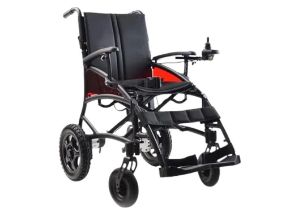
It's natural to assume that a lighter chair must be a flimsier one. Carbon fibre turns that on its head. The AeroCarbon Powerchair has a carry weight of just 12 kg, yet it supports users up to 136 kg (21.4 stone), more than the heavier AirFold Carbon (115 kg) or InstaFold Powerchair (120 kg). Among our folding scooters, the Jaunt matches that 136 kg (21 stone) capacity at the other end of the price scale.
Whatever you're considering, check the maximum user weight first and leave yourself some margin. A lighter lift is never worth choosing a chair or scooter that isn't built for the person using it.
When Heavier Is the Right Choice
A heavier model isn't a worse one, it's often a trade for price or convenience. A few honest examples:
InstaFold Powerchair (€999, 25 kg). The most affordable way into a folding powerchair. It folds in one simple action, like a pushchair, and its 24V 10Ah lithium battery is airline-friendly. If the chair lives mostly at home, or a family member does the lifting, the extra weight is a fair trade for the saving.
AutoFold Elite (€2,699, 27 kg). It folds and unfolds itself in around 15 seconds with the remote or the tiller buttons, so there's no bending over the frame. For anyone who finds folding harder than lifting, or who has someone to help with the lift, that matters more than the kilos.
Jaunt (from €799, 48 kg). The heaviest scooter here in total, largely because of its lead-acid batteries, which help keep the price down. Split into five parts, though, nothing weighs more than 15.9 kg.
At the other end, carbon fibre costs more. The AeroCarbon Scooter (€3,999) is the lightest scooter we sell to lift as a single folded piece, at 13 kg with the battery out, and the AeroCarbon Powerchair (€2,099) is the lightest powerchair. You're paying for every kilo you don't have to lift.
Five Questions to Answer Before You Choose
1. Who will lift it, and how often? If you'll be loading it on your own every day, the heaviest single lift should be your first filter. If there's always a second pair of hands, you have more choice.
2. What car will it travel in? Measure the boot opening, note how high the boot lip is, and compare both with the folded size. A crossover and a hatchback can change the answer.
3. Will it fly? If holidays are part of the plan, look at the battery's watt-hours before anything else, and check your airline's rules.
4. What does the user weigh, in stone? Choose a model whose maximum user weight sits comfortably above it. This is the one number you can't compromise on.
5. What's the budget? Carbon fibre is lighter and costs more; aluminium and lead-acid are heavier and cost less. And because no VAT is charged on mobility scooters or powerchairs in Ireland, the price you see is the price you pay.
Lift It Before You Buy It
A spec sheet can tell you what a scooter or powerchair weighs. Only your own hands, your own car and your own front step can tell you whether that weight works for you. That's why we offer free in-home demonstrations anywhere in the Republic of Ireland: our specialist brings the models you're weighing up to your door, and you try the lift into your own boot before you decide. No obligation, no pressure.
Prefer to see the range in person? Visit our showrooms in Dublin or Portlaoise, Monday to Friday. Browse every folding mobility scooter and powerchair at betterliving.ie, or call us on 0818 989 353.
Read next: Folding Mobility Scooters: The Complete Guide to Portable Independence: how each of our scooters folds, compared side by side.