





A riser recliner that fits properly lets you sit with your feet flat on the floor, your knees at about 90 degrees and your back supported, then stand up without straining. One that doesn't fit can leave your feet dangling, your hips squeezed or your knees higher than your hips, and that makes the lift harder work, not easier.
The good news is that you only need four measurements, and they take about five minutes. Three are of you, and one is of your room, the one most guides forget.
What you need:
- A tape measure (a metal one is easiest)
- A firm, upright dining chair
- A pencil and paper, or the table further down
- A helper, if you have one. It's much easier when someone else holds the tape
Wear the shoes you usually wear at home, because a thick slipper sole can change your seat height by a centimetre or two.
Measure in four steps
Sit on the firm dining chair, well back in the seat, with your feet flat on the floor and your knees bent at about 90 degrees. Take all three body measurements in this position.
- Seat height: floor to the back of your knee. Measure straight up from the floor to the crease behind your knee. This is the seat height that suits you. Your feet should rest flat when you sit, so a seat that is too high leaves them dangling, and one that is too low puts your knees above your hips and makes standing harder.
- Seat width: across your hips. Measure across the widest part of your hips or thighs, then add about 5 cm. That gives you room to shift and get comfortable without sliding around. A seat that is far too wide gives poor support at the sides and puts the armrests out of easy reach when you push up.
- Seat depth: back of your bottom to the back of your knee. Measure from the back of the chair, where your bottom touches it, to the crease behind your knee, then take off about 5 cm. You should be able to fit two or three fingers between the front edge of the seat and the back of your knee. Too deep and you'll slump forward to reach the floor; too shallow and your thighs won't be supported.
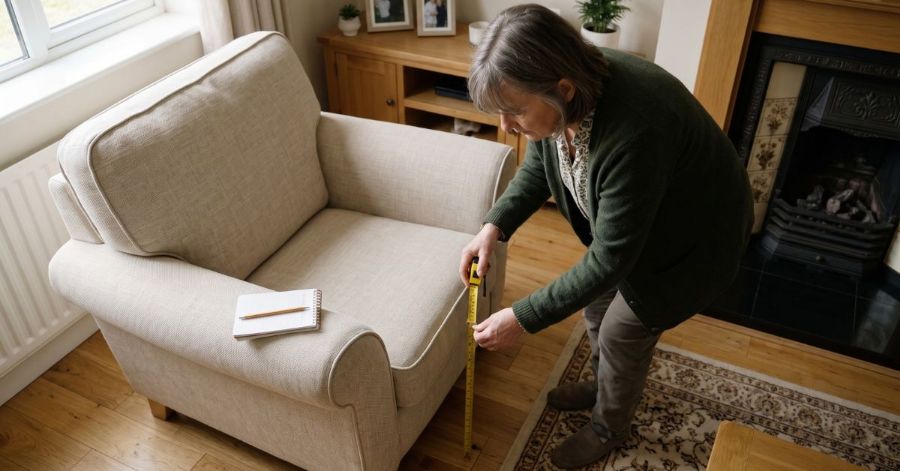
- Room: the space the chair needs when it reclines. This is the one most guides forget. Measure the space where the chair will go, from the wall forward and from side to side. Remember that a recliner reaches further forward when the footrest is up, and the backrest may need a gap behind it to tilt back. Leave clear space in front so you can stand up and step away, with room for a walking frame if you use one. Then measure the narrowest door the chair must pass through on its way in.
Our product pages list each chair's width and depth when upright. For the reclined length or how far from the wall a particular model should sit, call us on 0818 989 353 and we'll check it against your measurements.
Your measurements
Copy this table, or print the page, and fill in your numbers as you go.
Measurement | How to take it | Your number | The chair you want |
Seat height | Floor to the back of your knee, shoes on | ____ cm | Seat height about the same |
Seat width | Across your widest point at the hips, then add 5 cm | ____ cm | Seat width about the same |
Seat depth | Back of your bottom to the back of your knee, then take off 5 cm | ____ cm | Seat depth the same or a little less |
Room space | Wall forward, and side to side, where the chair will go | ____ × ____ cm | Fits with room to recline and stand up |
Narrowest door | Width of the tightest doorway on the way in | ____ cm | Ask us if the chair is wider |
Your weight | Your weight today | ____ kg | Under the chair's maximum user weight |
If you're between sizes
- Seat height: choose the lower seat. Your feet must reach the floor, and the riser lifts you to standing, so a slightly low seat is easier to live with than a high one.
- Seat width: choose the wider seat, as long as you can still rest your hands on both armrests to push up.
- Seat depth: choose the shorter seat, so the front edge doesn't press into the back of your knees.
- Weight: check the maximum user weight first. Over 125 kg, look at the Joyce (150 kg) or the Alaska Extra Large (200 kg).
Still unsure? Send us your numbers and we'll suggest the right size.
Match your numbers to a chair
Find the row whose seat height, width and depth sit closest to your numbers. Prices and sizes were checked on betterliving.ie on 1st November 2026.
Chair and size | Seat height | Seat width | Seat depth | Max user weight | Price |
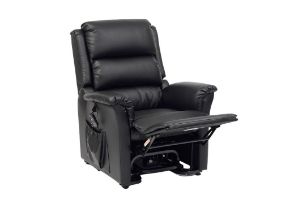
Joyce Black Faux Leather, Petite | 45 cm | 44 cm | 49 cm | 150 kg | €859 |
Opera Collection, Petite | 46 cm | 46 cm | 46 cm | 125 kg | from €998.99 |
Joyce Black Faux Leather, Standard | 48 cm | 49 cm | 51 cm | 150 kg | €859 |
Opera Collection, Standard | 48 cm | 51 cm | 50 cm | 125 kg | from €998.99 |
Joyce Black Faux Leather, Large | 48 cm | 52 cm | 52 cm | 150 kg | €859 |
Opera Collection, Grande | 51 cm | 56 cm | 53 cm | 125 kg | from €998.99 |
48 cm | 72 cm | 54 cm | 200 kg | €2,099 |
The Opera Collection is six end-of-line styles (Albany, Delby, Flynn, Parker, Swinton and Vionna), and on the styles we checked the sizes match the figures above. Stock is limited, so check which sizes and colours are left before you order.
When to ask an occupational therapist
A tape measure tells you which chair fits your body today. An occupational therapist (OT) looks at the bigger picture: how you sit, how you stand up and how you'll manage in the months ahead. If your mobility is changing, or you're buying for someone with a health condition, their opinion is worth having before you choose.
What an OT can bring to the decision:
- Posture and support. They can see whether you need extra support at the sides, the head or the lower back, and whether a standard seat will hold you comfortably for hours at a time.
- Getting in and out safely. They'll watch how you sit down and stand up, and judge how much help the riser should give and how the armrests should sit.
- Skin and pressure care. If you sit for long periods, they can check your risk of pressure sores and advise on cushions or a different type of chair.
- Planning ahead. For a condition that may progress, an OT can suggest a chair that will still suit you in a year or two, so you're not buying twice.
- Your home as a whole. They'll look at the room, the route to the chair and the rest of your day, not just the chair itself.
How to get in touch with one:
- Through the HSE. Public OT services are run through primary care centres, hospitals and community services. Ask your GP or public health nurse about a referral, or contact your local health centre. Waiting lists can be long.
- OThub.ie is a free directory of private occupational therapists in Ireland, where you can find an OT who covers your county. Always ask about fees before you book.
- After a hospital stay. If you're recovering from surgery, ask the hospital OT about seating before you're discharged.
Bring your measurements table to the appointment. It gives the OT a head start, and you can bring their recommendations back to us so we can match them to a chair in our range.
Five minutes now saves a return later
With four numbers on paper, you can shortlist a chair with confidence: feet flat, knees at 90 degrees, back supported and room to recline. Browse our riser recliner range, or call us on 0818 989 353, Monday to Friday, with your measurements and we'll help you choose.